.svg)


Before VOUS was launched, Crews became the foundation the church was built on. The mission hasn't changed since day one. The method has. It’s evolved in maturity, growth, and the new ways we've learned to build and disciple people.
The Model
Rhythm: Bi-weekly gatherings
Season length: 6 weeks (about 3 months, meeting every other week)
Seasons per year: 3
Reset period: 1 month off between seasons
Healthy group size: 10-12 people
Locations: Homes, restaurants, casual public spaces
We meet all around Miami, wherever people can gather and actually talk. Each Crew is meant to stay small, so if a group grows too large, it breaks into smaller discussion circles so every person still gets the chance to speak.
The month off matters as much as the six weeks. It's not just a break, it's a working reset. Leaders use it to review what worked, onboard and train new leaders, and rethink structure before relaunching. For members, it's a chance to rest from the weekly rhythm while still building relationship organically with off-season hangs, casual catch-ups, nothing forced. It also builds anticipation for the next season to start.
We don't assign a fixed group size, we watch for it. Once a Crew grows past 10-12, we look for the "building blocks" already inside the group: people ready to help launch a new one, and part of the Crew Leader’s focus shifts to raising up new leaders.
Inside a Crew
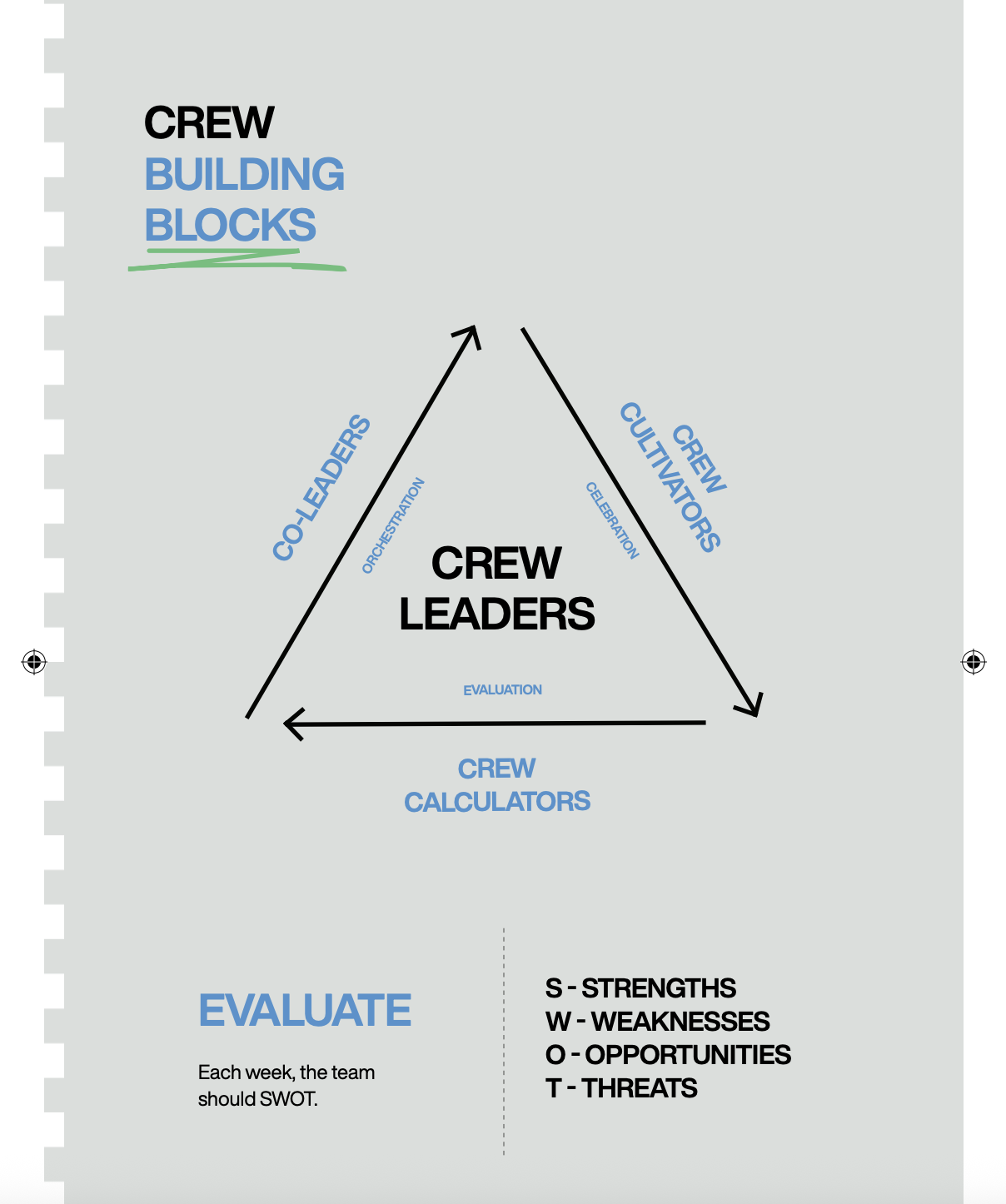
Every Crew runs on three roles working together:
- Co-Leader — supports the Crew leader and helps Crew run smoothly.
- Cultivator — sets the vibe, shares stories and celebrations. Usually the outgoing, active personality in the room.
- Calculator — keeps track of Crew numbers and data. The detail-oriented one, responsible for the tasks and the tracking.
Crew Night Structure
Leaders arrive 15-30 minutes early to receive people, assign the week's tasks, and pray over the people and the space before anyone walks in. As people arrive, they're greeted, then eased in with an icebreaker, something to break the ice or just break the tension of the week.
From there, the group moves into discussion, built from the week's Crew notes, with room for follow-up questions if the conversation calls for it. It's not meant to be a surface-level discussion, it's meant to build real conversation. Leaders close with a summary and a call to action, prayer prompts for the week ahead, and announcements to keep people connected to the life of the church.
Crew doesn't end until prayer requests and praise reports happen. It's one of the most meaningful parts of the night, the moment that shows what Crew is actually for.
Crew Discussions
Every Sunday, a team of servant leaders starts crafting the week's Crew notes, each one digesting the message from their own lens. Monday, they come together, pull it up on a screen, and go through it as if they were sitting in Crew themselves. The goal is always the same: questions that aren't yes-or-no, questions that provoke real thought, and questions that work whether you're brand new to church or you've studied the Bible your whole life. Once the questions are set, the real work happens in the room: people getting a safe space to speak into each other's lives.
To see the most recent Crew discussion to see the final product, visit vouschurch.com/crews
Growing Leaders
Crew runs on layers of leadership built through discipleship and training up:
Crew Leader: Leads the Crew week to week
Crew Coach: Builds relationship with new leaders, checks in on how Crew is going, teaches leaders to build leaders
Crew Captain: Oversees brand new Crews, supports and equips Coaches
Crew Coordinator: Location-level oversight
When a leader is ready to raise up a new one, they're encouraged to find someone already close to them, someone they serve with, a friend, someone already in their Crew, to be "yoked" with in leading. That recommendation goes to the Crew department, which reaches out to the potential leader directly. From there: a Crew leader interest meeting, an interview, reference forms, training videos, and a gathering night to meet Crew Captains and Coaches.
If a Co-Leader or building block is called to lead their own Crew, they're released into it. That's the goal of the whole structure.
The Impact
The stories are what make this real. People have met their spouse through Crew. People have grieved losses alongside their Crew. People have celebrated milestones with the people who know them best. We've watched people who once sat in the room too shy to talk grow into leaders running their own Crew.
We measure it both ways, quantitatively and qualitatively. On the numbers side, we track how Crews are doing week to week. But just as important are the stories: how people are actually experiencing Crew, and what it's building in them.
Resources for Other Churches
If your church is considering something like this, here's what our Crew department wants you to know:
- Get the leaders right first. The structure matters less than who's leading it. Be clear with your leaders about what their role actually means.
- Look for reliable, consistent people who genuinely care about people. That matters more than charisma or experience.
- Build for your city, not someone else's model. For us, that's meeting in homes and casual Miami spots. Pay attention to what actually works for your context.
- Let group size be a signal, not a rule. Watch for when a group has the building blocks to multiply, and invest in people until they do.
- Protect the off-season. The month between seasons is when leaders reset, retrain, and rebuild for what's next.
- Don't skip the closing moment. Whatever your version of prayer requests and praise reports looks like, protect it. It's often where people feel Crew the most.