.svg)


Every year, thousands of Miami families show up to Charles Hadley Park not quite knowing what they're walking into. They come for eggs. They leave having encountered something much bigger.
That's the quiet genius behind VOUS Church's Easter Egg Drop, one of VOUS’s largest community outreaches, drawing over 6,000 attendees, distributing 80,000 eggs, and this year, witnessing 17 people give their lives to Jesus. On a Saturday morning at a public park.
But none of it happens by accident.
Behind the joy and the chaos and the colorful crowds is an eight-week machine, a cross-departmental system of timelines, team structures, creative pipelines, and communication strategies built to serve a city at scale. We're pulling back the curtain so your church can learn from it, steal from it, and maybe one day run something just like it.
Part One: The Operational Framework
The 8-6-4 Runway
The Easter Egg Drop doesn't start in April. It starts in February.
We have an eight-week runway for Easter Egg Drop since it's our largest Tier 1 event, so it gets our largest runway. That runway is broken into three distinct phases that keep the machine moving without overwhelming any one team.
Weeks 8–7 (Internal): The event team goes internal first by reviewing the SWOTs (Strengths, Weaknesses, Opportunities, Threats) from the previous year, revisiting the prior year's deck, and generating new ideas before any other department touches the plan. This is the ideation and infrastructure-building phase: creating the playbook, building templates, and preparing everything that will eventually be handed off.
Week 6 (All-Departments Kickoff): At six weeks out, every department is brought into a formal kickoff meeting. This is when collaboration begins across the full staff: production, worship, communications, creative, and operations all aligned around the same plan.
Week 4 (Lock-In): By four weeks out, all quotes are finalized, all big ideas are on the table, and the team begins locking in concrete details. From that point forward, it's execution mode, smoothing out the details and running toward the day.
This 8-6-4 framework gives departments breathing room while maintaining momentum. It's a simple structure, but it's the kind of clarity that prevents the last-minute scramble that plagues so many large-scale events.
The Team Structure
The Easter Egg Drop runs on a layered leadership model built for both scalability and accountability.
We start with an Event Director, the person who spearheads the event and owns the vision for how everything comes together. Below that sits a role that VOUS has developed over the years and calls the Event Coach: a seasoned servant leader who has served the event multiple times and is brought in specifically to oversee logistics. The Event Coach is responsible for keeping the playbook updated, ensuring the run-of-show and slides are all cohesive, and smoothing over the operational details that fall between the cracks.
Under the Event Coach are Team Leaders for every zone represented at the event. And alongside each zone are I Love My City Supports, two per zone, who don't lead a team themselves but provide real-time support across the floor.
It's a structure designed so that no one person is carrying too much. The Event Coach frees the Event Director to think big. The zone Team Leaders free the Event Coach to oversee everything. The I Love My City Supports keep the whole thing from breaking under pressure.
Volunteers: 200 Strong
Pulling off Easter Egg Drop requires a minimum of 200 servant leaders across all departments from production, worship, I Love My City, and operations.
Recruitment happens through two channels: the platform (leadership talks about it from the stage) and direct email outreach to anyone who has ever served at an I Love My City event. But recruitment is only half the equation. Equipping those volunteers is what actually makes the day work.
Two weeks before the event, Team Leaders only are brought onto a Zoom call for a high-level walkthrough of every detail. From there, Team Leaders are empowered to build a one-pager specific to their zone. The following week, all servant leaders, every single person who signed up to serve, joins their own Zoom breakout, led by their Team Leader using that one-pager.
By the time Saturday arrives, every volunteer already knows their call time, their role, and what to expect. It's a practice that has been perfected over the years, and it's a game-changer, the difference between a volunteer who shows up ready and one who shows up confused.

80,000 Eggs: The Logistics
Of the 80,000 eggs distributed this year, 60,000 came pre-packaged with candy already inside. The remaining 20,000 were filled by hand by over 100 servant leaders who gathered at VOUS locations in January and March for dedicated I Love My City packing days.
It's worth pausing on that detail. Egg stuffing isn't just logistics. It's momentum. It's 100 people, months before the event, getting excited about what's coming. "It gets people pumped," the team notes. It's an easy entry point for serving: accessible, low-barrier, and genuinely fun, and it plants the seed of Easter Egg Drop in the community's heart long before the event itself arrives.
The Hardest Problem: Getting 6,000 People In
Every large-scale event has an Achilles heel, and for Easter Egg Drop, it's ingress and egress, getting thousands of people onto and off a public park site without bottlenecks.
"Getting 6,000 people into an event with little to no wait time, and making it a fun experience for everyone: that's our biggest challenge," the team shared.
The solution has evolved over the years. This year, VOUS deployed check-in lanyards with QR codes, positioned check-in stations at every potential entry point (including every parking approach), and placed an operational lead at each check-in to actively manage flow in real time. They're still perfecting it, but the commitment to having a leader with decision-making authority at every entry point has made the biggest difference.
Also critical: the relationship with the City of Miami and the Miami Police Department. VOUS now proactively communicates the event scale in advance, ensuring police are properly staffed for the day. That relationship, built over years, doesn't happen on its own, it has to be cultivated.
Part Two: Creative & Art Direction
Building the Look
The visual identity for Easter Egg Drop is born out of a simple starting point: a designer, a Pinterest board, and a question: what do we love?
"I start by pulling references from Pinterest or other design platforms," says the designer who led the Easter Egg Drop creative direction this year. "This year I wanted to go really colorful and bold."
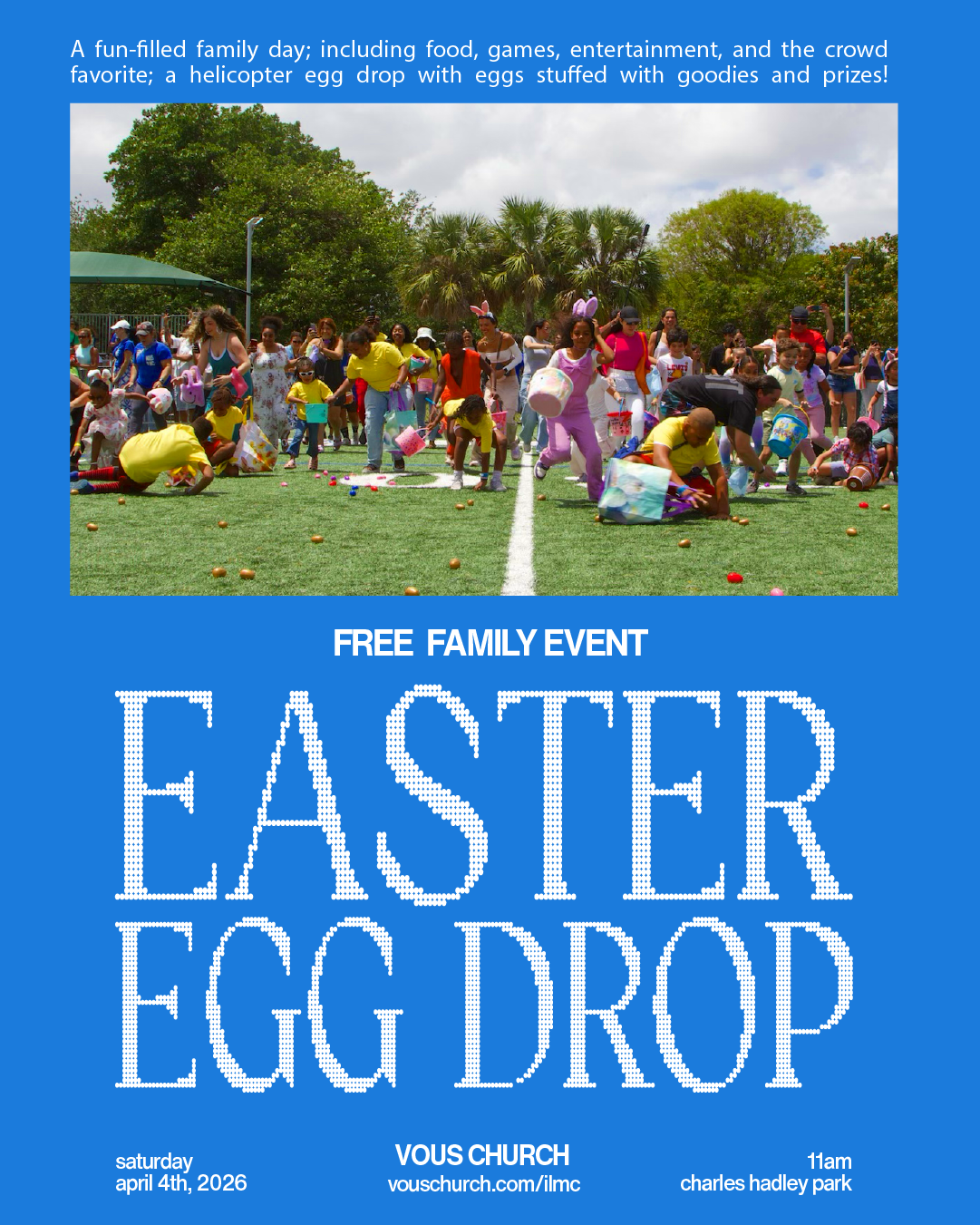
From that initial direction, a theme board is assembled. Typography is chosen deliberately. This year's headline font was selected because it visually evoked eggs within the letterforms themselves, a playful choice that immediately communicated the event's energy and its target audience: kids and families.
Color palettes came next. The initial direction was yellow and red: punchy, warm, energetic. But design doesn't always survive contact with the broader campaign, and that's a lesson worth naming explicitly.
The Color Pivot
Midway through the creative process, the Easter Egg Drop palette shifted from yellow and red to a bold blue. The reason? Cross-team communication.
When the full Easter campaign came into view, Easter Egg Drop, Good Friday, and Easter Sunday all running simultaneously, the yellow-and-red palette the Easter Egg Drop designer had chosen turned out to be the same palette another designer was using for Easter Sunday. The film team was also working in the same color family.
"I realized I need to make sure I'm in communication with all the departments involved in the Easter campaign," the designer reflects. "Because while this is its own look, it also needs to be cohesive with the other campaigns taking place within the larger one."
The pivot was a design process working the way it should. It just happened to surface a lesson about the importance of cross-team alignment early in the creative sprint, not halfway through it.
For other churches with creative teams managing multiple simultaneous campaigns: the moment you open a new design file for a sub-event, it's worth a five-minute conversation with whoever is designing the parent campaign.
Cohesion Across Every Touchpoint
With the direction locked, the Easter Egg Drop creative assets expanded across every surface the event would touch: touch cards, email headers, social posts, event signage, digital displays.
"Knowing at the beginning of the project that we will create signage, digital assets, and print items when we start creating initial concepts is really important," says the designer. Starting with the full scope in view means every layout and color decision is made with all its future applications already accounted for. The Instagram post and the park banner share DNA from the very first sketch.
The Easter campaign across Good Friday, Easter Egg Drop, and Easter Sunday was unified by a consistent use of bold colors and expressive typography, each event having its own look while remaining clearly part of the same family. That coherence doesn't happen by accident. It happens because two designers are in constant communication, treating the full Easter season as a single creative project with multiple chapters.
A Creative Culture of Permission
Two pieces of guidance from leadership shaped the approach: "It's OK to play" and a repeated question from the department director: "Do you love it?"
The love and the passion behind what we create is going to be felt on the other end.
It's a small culture note worth passing along. We’ve found that when we create a permission structure for the creative teams, where play is encouraged and personal love for the work is treated as a quality standard, we tend to produce design that actually feels like something. The work carries the feeling of the person who made it. And congregations, and cities, feel that.
Part Three: Communications & Marketing
The Rollout Timeline
VOUS runs a tiered communications strategy for Easter Egg Drop that mirrors the event's operational runway, starting early with the warmest audiences and expanding outward as the event approaches.
4 weeks out: Outreach begins to the external guest list, anyone who has attended a previous VOUS community event (Easter Egg Drop, Toy Bash, Back to School Bash). These lists are pulled directly from past Eventbrite registrations, making them a high-quality, high-intent audience.
3 weeks out: Internal audiences enter the communication cadence, location community members, servant leaders, and the all-church list via weekly Friday emails.
Weekly from there: Emails go out every Wednesday to the external and internal lists through the run-up to the event.

Eventbrite as a Communication Platform
Most churches think of Eventbrite as a ticketing tool. VOUS treats it as a communication platform.
The registration data builds a contactable list that can be reached even when people have unsubscribed from the church's primary email platform (Mailchimp). Eventbrite's internal email marketing fills that gap, recovering a slice of the audience that would otherwise be unreachable.
Eventbrite also enables geographic ad targeting. VOUS runs paid ads reaching people within a 30-mile radius of the event location. For a church trying to reach families outside its congregation, this is one of the most effective tools in the toolkit.
Grassroots Reach
Paid channels are only part of the strategy. VOUS invests heavily in grassroots outreach: local organizations, schools invited to share the event with their own families, and submissions to the City of Miami and Miami-Dade County community event pages.
That last point matters more than it might seem. When families search "Easter events in Miami," the county and city community event pages rank well. Being listed there drives organic traffic directly to the Eventbrite page. It’s free, credible, and high-intent.
Same-Day Content
On the day of the event, VOUS's photo team is pre-assigned to specific shots and designated zones across the park. Images are captured and transferred immediately and imported into a shared stream specific to the event. The social media team pulls from that stream in real time, posting while the event is still unfolding.
The goal isn't to document the event. It's to invite the city into it while it's happening.

Part Four: What Success Actually Looks Like
Six thousand people attended Easter Egg Drop 2026, but attendance was never the only measure.
A successful event will always turn into people going to church, being saved, or at the very least knowing that there is a church that loves them. There is a God who sees them and cares for them.
This year, 17 people gave their lives to Jesus at what many of them thought was a free egg hunt in a public park. Seventeen. At an event where the vast majority of attendees had no prior connection to the church.
VOUS made a deliberate choice two years ago to introduce a community engagement team whose sole focus on I Love My City days, including Easter Egg Drop, is to invite every single person they encounter to church. To have real conversations. To hand out flyers and be present with people while they wait.
That's the intention behind the connect cards placed in the hands of people waiting on the field. That's the gospel presentation that happens while families are gathered together, expecting eggs. That's the Connect Corner stationed at every entrance.
The eggs are the invitation. The church is the point.
What We'd Tell a Church Starting From Scratch
Start simple. Find a park that will attract your desired community. Get some eggs. Keep the budget to what's actually in your hands.
Find passionate people. More than any other variable, more than budget, more than logistics, more than how many eggs you can source, passionate people are what make an event like this work. They carry the energy. They have the conversations. They invite strangers to church.
Have a clear gospel intention. Every element of Easter Egg Drop: the community fair, the connect cards, the gospel presentation on the field, the engagement team moving through the crowd, exists because the church exists to bring people who are far from God close to Him. The eggs get people there. But the point is always Jesus.
In summary, find a budget that works, do what is capable in your hands, and know that God will breathe on it and God will bless it.